Commercial doors must perform under pressure. Employees, customers, deliveries, weather, and security demands can test them every day. A weak or poorly fitted door may soon become difficult to operate, costly to maintain, or vulnerable to damage.
For many commercial properties, hollow metal doors provide the strength and versatility needed for demanding openings. They can serve offices, warehouses, schools, healthcare facilities, retail buildings, and industrial sites. When properly selected and installed, they offer a practical balance of durability, security, and long-term value.
What Is a Hollow Metal Door?
Despite its name, a hollow metal door is not simply an empty steel shell. It is typically made with steel face sheets surrounding an internal core. Depending on the required performance, that core may use honeycomb, polystyrene, polyurethane, or another engineered material.
The core helps maintain the door’s shape while supporting insulation, sound control, or impact resistance. Reinforced areas can also accommodate hinges, closers, locks, exit devices, and other commercial hardware.
Doors are available in different steel gauges, construction levels, designs, and finishes. The appropriate specification depends on the opening’s location, traffic level, security needs, exposure, and applicable building requirements. The Steel Door Institute’s selection and usage guidance offers helpful criteria for matching standard steel door levels with different applications.
Built for Demanding Commercial Settings
Durability is one of the main reasons property owners choose steel door assemblies. They resist common damage better than many lighter materials and are well suited to areas where carts, equipment, packages, or frequent foot traffic may strike the opening.
Their value extends beyond impact resistance. Properly specified doors can support several business priorities:
- Better control over restricted or service areas
- Compatibility with commercial locking and access-control hardware
- Resistance to warping, cracking, and everyday wear
- Options for interior and exterior openings
- Configurations that may support fire-rated assemblies when required
- A clean appearance suited to many commercial environments
These benefits make metal doors useful for back-of-house entrances, utility rooms, stairwells, stockrooms, mechanical spaces, loading areas, and main building access points.
Installation Determines Performance
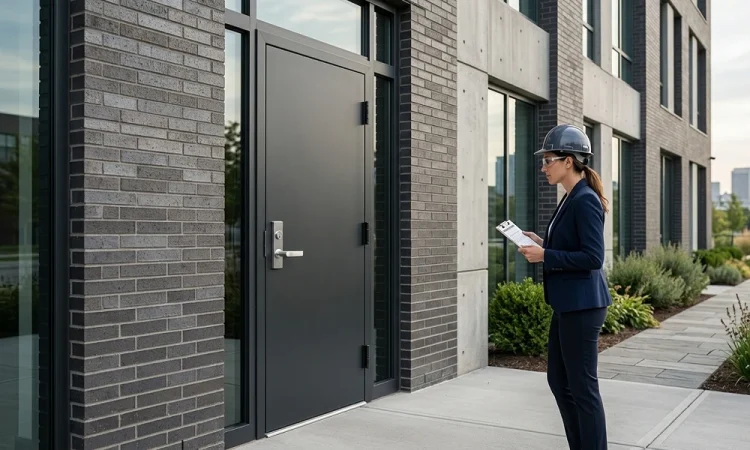
Even a well-built door may perform poorly if its frame is twisted, the anchors are loose, or the clearances are uneven. Accurate metal door installation helps the leaf swing smoothly, close fully, latch reliably, and work correctly with its hardware.
Technicians must assess more than the door itself. The wall construction, frame condition, opening dimensions, handing, hinge locations, threshold, weather seals, and hardware preparations all affect the completed assembly. Rated openings may also require approved components and closer attention to labels, clearances, and field modifications.
Installation quality matters because small errors can create persistent problems. The Steel Door Institute notes in its steel door installation resources that many performance issues come from improper fitting rather than the manufactured product. Careful measurement and adjustment at the start can prevent repeated service calls later.
Recognizing Common Repair Needs
A commercial door often shows warning signs before it stops working. It may scrape the frame, drag across the floor, slam shut, fail to latch, or require extra force to open. Loose hinges, worn pivots, damaged closers, misaligned frames, failing locks, and corrosion can all affect operation.
Professional metal door repair should begin with an inspection of the entire opening. Replacing one damaged component will not solve the problem if a bent frame or alignment issue caused that damage.
The right approach to fixing metal doors depends on the condition and function of the assembly. A technician may adjust or replace hinges, service the closer, realign hardware, repair limited surface damage, improve weather sealing, or correct clearance problems. More serious damage may make replacement the safer and more economical choice.
Repair or Replace?
Not every damaged door needs to be replaced. Minor dents, hardware wear, alignment problems, and some forms of corrosion may be repairable. A sound frame and an otherwise serviceable leaf can often justify targeted work.
Replacement may be preferable when the door has extensive rust, severe deformation, broken internal reinforcement, repeated operational failures, or damage that affects security. The decision also changes when the opening has a fire or life-safety function. Alterations to those assemblies should preserve their required performance and comply with applicable rules.
OSHA requires workplace exit-route safeguards, including fire doors, to remain in proper working order under its exit-route maintenance requirements. Property teams should therefore treat problems at exit and fire-protection openings as more than routine cosmetic defects.
Protecting the Investment
Routine care can extend service life and reduce unexpected failures. Facility teams should watch for loose fasteners, unusual movement, damaged seals, rust, closer leaks, and latching problems. Keeping thresholds clear and arranging service when symptoms first appear can prevent added strain on the door and frame.
Businesses planning a new opening or evaluating an existing assembly can turn to Commercial Door Works for practical service guidance. A professional assessment can determine whether adjustment, component replacement, repair, or a new door best fits the property’s needs.
Choose a commercial opening that can handle daily use without becoming a daily problem. Visit Commercial Door Works to explore service options and request help with your property’s steel door needs.