You’ve got a block of land, a rough idea of the home you want, and two very different ways to get there. One is the familiar route: hire a local builder and construct the house on site. The other is to have the home built in a factory and delivered on the back of a truck.
People tend to have strong opinions about both. Let’s set those aside and compare them on the things that actually matter: time, money, durability and design.
Two Ways to Build
Site-built means the house is constructed in place. Footings go in, framing goes up, the roof goes on, and trades arrive one after another to finish it.
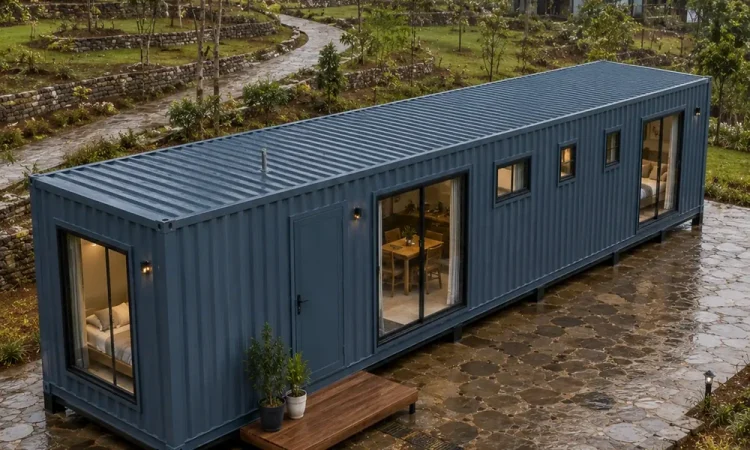
Factory-built modular container homes use steel containers, or container-shaped steel modules, as the structure. The modules are cut, reinforced, insulated and fitted out in a factory, then shipped to your land and set on a prepared foundation.
Speed: Factory Usually Wins
With a modular container home manufacturer, two things happen at once. The home is built in the factory while your site is being prepared. When the foundation is ready, the modules arrive and get connected.
Factory work also isn’t stopped by rain, snow or a heatwave. On a traditional build, weather, trade availability and late material deliveries can each add weeks, and delays tend to stack up.
That said, factory timelines aren’t instant. Production queues, shipping and permits still take time. The advantage is that more of the schedule is predictable.
Cost: It Depends More Than You’d Think
Here’s the honest answer: neither option is automatically cheaper.
Modular homes tend to have more predictable pricing because much of the work is fixed in a factory quote. Site-built homes can sometimes be cheaper in areas with low labour costs, but budgets can creep when problems pop up mid-build.
Both approaches share costs that people often forget:
- Site preparation and foundations
- Water, power and sewer connections
- Permits and inspections
- Driveways, landscaping and fencing
Modular projects add transport and crane hire, which can be significant for remote or hard-to-reach land. Always compare full project budgets, not just the house price.
Quality Control
Factories have a natural advantage here. The same team builds similar units repeatedly, with jigs, proper tools and inspections at each stage, out of the weather. Materials stay dry.
On a site build, quality depends heavily on the specific builder and trades you hire. A great local builder can produce excellent work. A rushed one can leave problems hidden inside the walls.
Durability Over Time
Steel container structures are very strong, but steel has its own needs. It must be properly coated against rust, especially in coastal areas, and it needs good insulation and ventilation to avoid condensation inside. With proper detailing and regular maintenance, a container home can last a long time.
Timber-framed site-built homes are also durable when designed and built well, and they’re generally easier to repair or extend using local trades who know the system.
Design Freedom
Site-built wins on pure flexibility. Almost any shape or layout is possible.
Container homes work within the width of the module, roughly 2.3 metres inside. That sounds restrictive, but it doesn’t have to be. Placing units side by side and removing shared walls, stacking them, adding decks and using large glass openings can create surprisingly generous spaces. Many custom container homes look nothing like a stack of boxes once they’re finished and clad.
A Simple Way to Decide
A factory-built container home may suit you if:
- You want a faster, more predictable timeline
- You like a modern or industrial look
- Your land has good access for trucks and a crane
- You prefer a fixed-price contract for the main structure
A site-built home may be the better fit if:
- You want a highly unusual or large design
- Your site is difficult to reach with heavy vehicles
- Local planning rules are unfriendly to container structures
- You plan to extend the house significantly in future
Final Thoughts
There isn’t a universal winner. The right choice depends on your land, your local rules, your budget and how quickly you need to move in. Get detailed quotes for both, ask what each one includes, and visit finished homes of each type if you can. Standing inside a real house tells you more than any comparison chart.