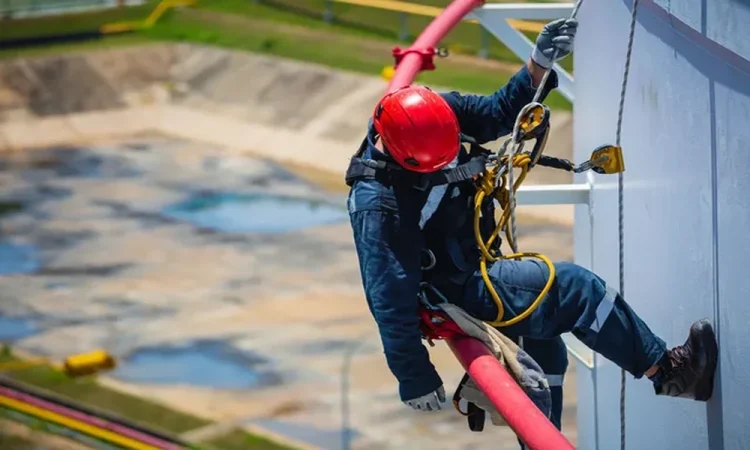
Rope access repair work has become an established method for conducting maintenance, inspection, and repair tasks on the external faces of Singapore’s high-rise buildings. The technique, which involves trained operatives suspended from rigged anchor points at height, offers a practical alternative to scaffolding in situations where the cost, time, and access disruption of a full scaffold are not justified by the scope of the work. For targeted repairs to cladding, waterproofing, sealants, and paint on tall structures, rope access often produces better outcomes in less time at lower cost.
What Rope Access Involves
Rope access systems are built around a redundancy principle. A working line supports the operative and allows controlled ascent and descent. A separate safety line is independently anchored and carries a fall arrest device that would halt a fall if the working line were to fail. The two-line system is a fundamental requirement of the international rope access standards that govern this type of work.
Operatives working on rope access systems are trained to standards set by bodies such as the Industrial Rope Access Trade Association, known as IRATA. Certification through IRATA is widely recognised as the global benchmark for rope access competence, covering both the technical skills of rope management and the safety knowledge required to work safely at height over extended periods.
In Singapore, rope access repair work is regulated under the Workplace Safety and Health Act, which sets requirements for working at height across all industries. Companies conducting rope access work are required to implement and maintain a documented safety management system, and operatives must be competent for the specific tasks they perform.
Applications in Building Maintenance
The range of repair and maintenance tasks that can be accomplished through rope access is broad. For building facades, the technique is used for external paint inspection and touch-up, sealant replacement at curtain wall joints and window perimeters, cladding fixings inspection and repair, crack stitching and grouting, waterproofing membrane repair on vertical surfaces, and concrete spall repair.
For waterproofing-specific applications, rope access allows specialists to access parapet walls, cantilevered balconies, and roof overhangs where waterproofing membranes or sealants have failed. The operative can apply sealant, membrane patches, or liquid waterproofing products with the same precision that would be possible from a scaffold or lift platform, but without the preparation time and obstruction that those approaches require.
Inspection work is also well-suited to rope access. A trained inspector descending a building face can conduct a far more thorough visual inspection of external cladding, sealant joints, and surface coatings than is possible from the ground or from a building inspection gondola, because the operative is in direct contact with the surface.
Advantages Over Scaffolding
For repairs affecting a limited area of a building facade, scaffolding is almost always more expensive and slower to mobilise than rope access. A scaffolding system must be designed, permitted, erected, inspected, and dismantled, a process that may take days to weeks for a tall building and imposes significant costs regardless of how little time the repair itself takes.
Rope access mobilisation is significantly faster. A team of two or three trained operatives can be rigged and working on a target area within hours of arriving on site. “Speed of response matters in building maintenance,” said Dr John Keung, former chief executive of the Building and Construction Authority. “A cladding crack or waterproofing failure that is addressed quickly causes far less secondary damage than one that waits weeks for a scaffold to be erected.”
For building owners and managing agents, this speed advantage has direct financial implications. Water entering through an unrepaired facade defect causes damage that compounds over time, to insulation, to structural elements, to interior finishes. Addressing the defect through rope access repair as soon as it is identified prevents this secondary damage from developing.
Safety Standards and Competence Requirements
The safety of rope access work depends entirely on the competence and discipline of the team performing it. A poorly rigged anchor point, an incorrectly threaded descender, or a team that has not assessed wind conditions correctly creates risks that the equipment itself cannot mitigate. This is why the training and certification of rope access operatives matters as much as the equipment they use.
When engaging a rope access contractor for building repair work, verify that the operatives hold current certification from a recognised body such as IRATA. Ask to see the company’s safety management documentation and their incident record. A firm with a genuine safety culture will welcome this scrutiny and will be able to demonstrate compliance with Singapore’s Workplace Safety and Health requirements clearly.
Ask also about their experience with the specific type of repair required. Rope access skills are transferable, but knowledge of waterproofing systems, sealant products, or concrete repair techniques is separate from rope access technique and must be assessed independently.
Choosing the Right Contractor
Not all rope access contractors in Singapore have the same depth of technical capability for building repair work. Some are specialists in inspection and survey, others in cleaning, and a smaller number have genuine expertise in the full range of building repair tasks that rope access enables.
When the scope includes waterproofing, sealant replacement, or concrete repair, look for a rope access repair contractor with demonstrated capability in those specific disciplines. Ask for examples of completed projects of similar scope, check references from building owners or managing agents, and confirm that the team includes both certified rope access operatives and technicians with the specific repair skills the project requires.